

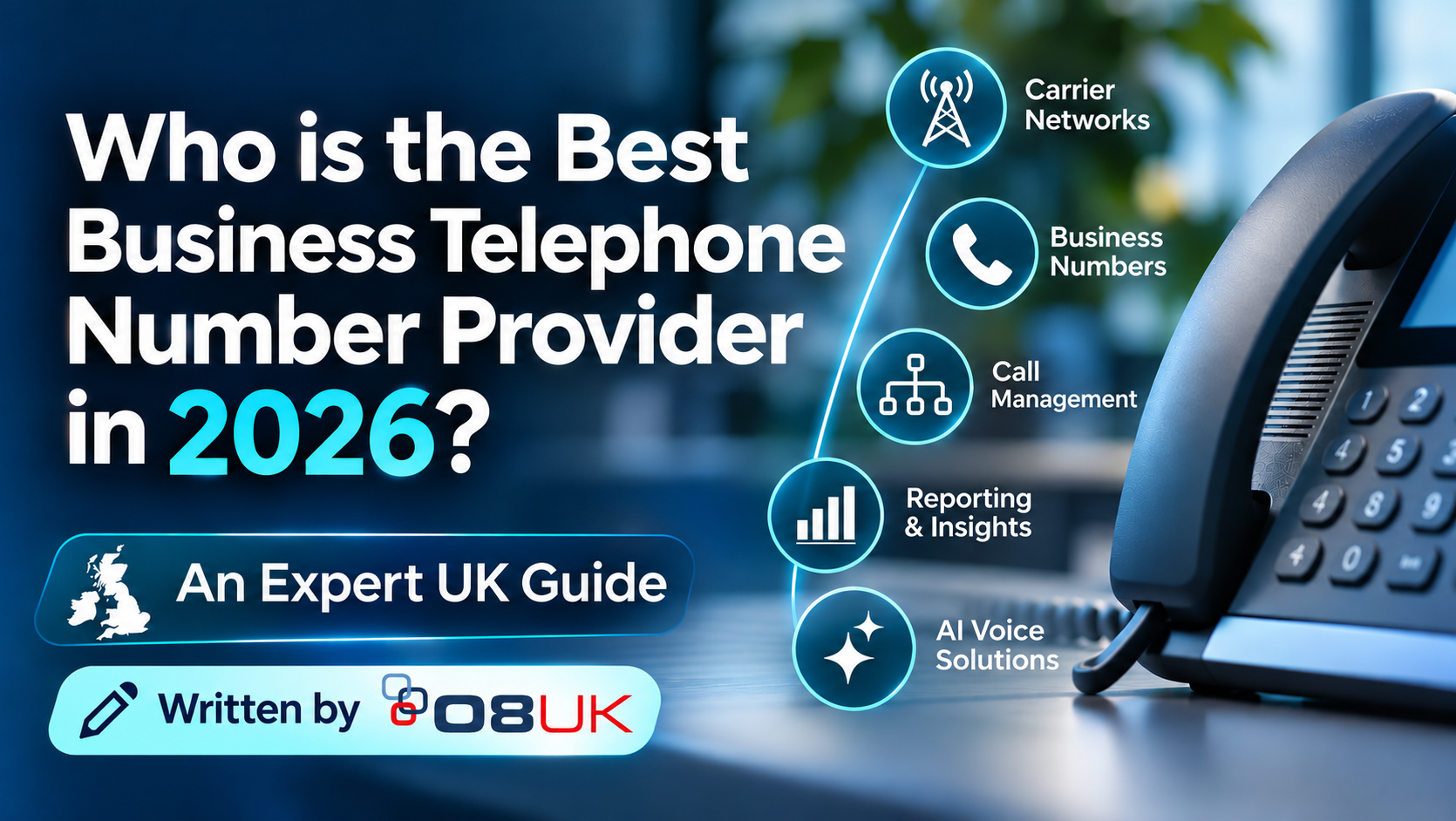
Who is the Best Business Telephone Number Provider in 2026? An Expert UK Guide
Who is the Best Business Telephone Number Provider in 2026? An Expert UK Guide
Finding the best business telephone number provider in 2026 is not necessarily about choosing the biggest telecoms company, the cheapest monthly rental or the supplier offering the longest list of features.
Some of the most important differences between UK telephone number providers are things that businesses may not initially be aware of.
Who actually hosts your telephone number? What happens if you want to move it? Are you paying for functionality that could be included elsewhere? How much control do you have over your inbound calls? And do you actually need a separate telephone system at all?
These are questions worth asking before committing to a telecoms provider, particularly if your business relies on telephone enquiries to generate revenue.
With over 20 years of experience in the UK inbound telecommunications industry, 08UK has put together this guide to help businesses make a more informed decision when choosing their telephone number provider in 2026.
Not All Telephone Number Providers Are the Same
When searching online for a business telephone number it can appear that most providers offer relatively similar services.
However, behind the scenes there can be considerable differences in how those services are delivered.
The UK telecommunications market includes network operators, independent telecoms specialists, resellers, hosted telephone system providers and businesses offering telephone numbers as part of wider communications packages.
Understanding these differences can help explain why two providers offering what appears to be the same telephone number may have very different pricing, functionality and service capabilities.
A modern business telephone number is capable of much more than simply connecting a caller to a telephone.
The infrastructure, technology, routing capabilities and expertise behind that number are equally important.
1. Understand Who Is Actually Behind Your Telephone Number
One of the less obvious questions to ask a telephone number provider is which network will host your number.
The company you purchase your telephone number from is not necessarily the network operator responsible for hosting it.
Many telecoms companies deliver services using third-party carrier networks. This is a normal part of the UK telecommunications industry and can provide businesses with significant benefits.
However, it is worth understanding the relationship between your supplier and the underlying network.
An independent telecoms specialist with access to multiple major UK carrier networks may have greater flexibility when it comes to:
-
Sourcing specific telephone numbers.
-
Transferring existing numbers.
-
Providing alternative routing solutions.
-
Supporting complex technical requirements.
-
Comparing different network capabilities.
-
Identifying suitable commercial arrangements.
Access to multiple networks does not automatically guarantee a better service but it can provide more options when a business has requirements that cannot easily be met by a single carrier. It can also allow a more robost disaster-recovery solution.
It is also worth establishing who is responsible for investigating technical faults and how quickly issues can be escalated to the underlying network operator.
Question to ask your provider: Which carrier will host my telephone number and what alternative options are available if my requirements change?
2. Do You Actually Need a Business Telephone System in 2026?
One of the biggest misconceptions in business telecommunications is that you need a dedicated telephone system to professionally manage your inbound calls.
Advances in network-based telecommunications mean that traditional inbound telephone system functions can be configured directly on your business telephone number.
These include:
-
Automated welcome messages.
-
IVR telephone menus (press 1 for sales, press 2 for accounts).
-
Call queuing and distribution.
-
Time-of-day and day-of-week routing.
-
Call recording.
-
Voicemail to email.
-
Hunt groups.
-
Overflow call handling.
-
Geographic call routing.
-
Disaster recovery routing.
-
Real-time and historical call statistics.
-
AI-powered telephone answering.
Calls can then be delivered directly to employees' mobile phones, landlines, SIP or IP channels or other compatible destinations, regardless of where they are working.
Consider a business with ten employees that requires a professional welcome message, departmental call routing, call recording and out-of-hours voicemail.
Rather than purchasing a hosted telephone system with ten individual user licences the business could configure these features directly on its telephone number and deliver calls to existing devices.
This approach can reduce monthly expenditure, simplify telecommunications infrastructure and provide greater flexibility whilst maintaining a professional inbound calling experience.
As the functionality sits within the network rather than on a telephone system, businesses can also redirect calls to alternative destinations should their office internet connection or usual call destination become unavailable, provided suitable routing has been configured.
Furthermore, cloud-based call management allows businesses to configure and update their inbound call routing remotely, from anywhere with an internet connection. Changes can be made without the need to access on-site equipment or arrange an engineer visit, giving businesses greater control, flexibility and the ability to respond quickly to changing circumstances.
At 08UK our philosophy is simple: start with what your business needs to achieve, rather than what technology you think you need to purchase.
Whilst some organisations may require additional solutions for outbound calling, internal communications or specialist integrations, many businesses can manage their entire inbound telephone operation directly through their business telephone numbers.
Question to ask your provider: Can you deliver the inbound call management functionality my business requires directly through my telephone number without the expense of a separate telephone system?
3. Choose the Right Number Before Choosing the Provider
The best telephone number for a business is not necessarily the most expensive, the most memorable or the one most commonly used by its competitors.
Different UK telephone number ranges serve different purposes.
| Number range | How callers are charged | Typical business use |
|---|---|---|
| 0800 and 0808 | Free from UK consumer mobiles and landlines | Sales enquiries, helplines and customer accessibility |
| 0333 and 0330 | Standard geographic rates and applicable inclusive minutes | Nationwide businesses and general enquiries |
| 0345 and 0370 | Standard geographic rates and applicable inclusive minutes | Established organisations and migrated legacy numbers |
| 0300 | Standard geographic rates and applicable inclusive minutes | Eligible public sector and not-for-profit organisations |
| 01 and 02 | Standard geographic rates | Local businesses and regional marketing |
A business operating nationally may prefer a non-geographic telephone number whilst a company serving a particular town or city may benefit from a local number.
Some businesses use different number ranges for different purposes.
For example, a company might advertise an 0800 number to attract new customers, use an 03 number for general enquiries and maintain local telephone numbers for regional marketing campaigns.
All of these numbers could potentially route calls to the same employees whilst providing different welcome messages, routing arrangements and call statistics.
Is a Memorable Business Telephone Number Worth the Investment?
For businesses investing in radio advertising, television, vehicle branding, outdoor advertising or printed marketing materials, a memorable telephone number can be a valuable marketing asset.
Gold and memorable telephone numbers are available across several UK number ranges, with distinctive digit patterns that can make them easier for customers to recall.
Rare six-digit 0800 numbers may also be particularly attractive to businesses looking for a shorter, more distinctive Freephone number.
However, not every business needs a premium telephone number.
The value of a memorable number will depend on how customers discover your business, how frequently the number is advertised and how important telephone enquiries are to your marketing strategy.
A good provider should be able to explain the commercial and practical implications of each option rather than simply recommending the most expensive number.
For further information about UK telephone number ranges and call charges, Ofcom provides independent guidance.
Question to ask your provider: Which number range is most appropriate for my business and why?
4. The Cheapest Telephone Number Provider May Not Be the Cheapest Overall
Comparing telecoms providers based solely on monthly number rental can be misleading.
The overall cost of an inbound telephone service may include number rental, call charges, call delivery charges, reporting, call recording, routing features and other administrative costs.
Two suppliers may advertise very different headline prices but the overall cost of their services can tell a completely different story.
Consider the following illustrative example of a business receiving 5,000 chargeable inbound minutes per month.
| Monthly cost | Provider A | Provider B |
|---|---|---|
| Number rental | £2 | £10 |
| Call charges | £200 | £150 |
| Call management features | £30 | Included |
| Call statistics | £15 | Included |
| Total monthly cost | £247 | £160 |
| Total annual cost | £2,964 | £1,920 |
In this hypothetical example, the provider advertising the higher monthly number rental actually costs £1,044 less per year.
These figures are illustrative rather than quotations from actual telecoms providers but they demonstrate why comparing headline prices alone may not provide an accurate picture.
Businesses with established inbound call volumes should ideally compare quotations using their actual usage data and required functionality.
It is also worth establishing whether additional functionality is charged individually or incorporated into the overall service price.
When reviewing your telecommunications expenditure consider all existing subscriptions and licences to identify whether you are paying more than once for similar functionality.
Other commercial considerations include minimum monthly spending commitments, inclusive minute allowances, out-of-bundle charges and whether call rates differ depending on the destination.
A transparent provider should be able to explain how your monthly bill is calculated and help you understand what you are paying for.
Question to ask your provider: What would my total monthly cost be based on my actual call volumes and required functionality?
5. Consider What Happens When Something Goes Wrong
Businesses understandably focus on how their telephone service will operate under normal circumstances. However, the quality of an inbound telecommunications solution can become particularly apparent when something goes wrong.
What happens if your office loses its internet connection? What if your usual call destination becomes unavailable? What if all your employees are already speaking to customers?
A well-designed inbound telecommunications solution may allow calls to be redirected automatically to alternative destinations when certain conditions occur.
These could include:
-
An alternative office or contact centre.
-
Employees working remotely.
-
Mobile telephone numbers.
-
An overflow answering service.
-
A voicemail or recorded announcement.
-
An AI-powered telephone answering service.
The appropriate solution will depend on the business and the nature of the disruption. Business continuity should form part of the initial service design rather than being considered after an incident has occurred.
Businesses should also periodically test their disaster recovery arrangements to ensure that alternative destinations remain available and that employees understand what happens during a service interruption.
It is important to understand that destination-level disaster recovery is different from resilience against an outage affecting the network hosting the number itself.
Having access to multiple carrier networks does not automatically mean that an individual telephone number is protected against every type of network outage. However, it does provide a more robust solution.
Ask your provider to explain both scenarios and what measures are available.
Question to ask your provider: If my normal call destination becomes unavailable how will my customers still be able to contact me?
6. Think About Number Portability Before You Need It
Businesses often only start asking questions about number portability when they have already decided to leave their existing telecoms provider.
By this point, their telephone number may have been advertised for several years and become closely associated with their brand.
It could appear on thousands of printed documents, company vehicles, websites, customer records and advertising campaigns.
Ofcom's number portability requirements support customers' ability to retain telephone numbers when changing providers. However, the practical arrangements can vary depending on the number range, underlying carrier and technical circumstances.
Before purchasing a telephone number it is worth understanding how a future transfer would be handled.
Businesses themselves should also maintain accurate records of their telephone numbers, service providers and account details.
This can be particularly important for organisations that have acquired other businesses or accumulated telephone numbers through several different suppliers over time.
When considering a number transfer, it is useful to establish:
-
Which carrier currently hosts the number.
-
Whether the number forms part of a larger range.
-
Whether other services are associated with the number.
-
What contractual commitments remain.
-
Whether there are any technical complications.
-
How the transfer will be coordinated to minimise disruption.
If you are considering moving an existing number do not cancel the service before the transfer has been successfully completed.
A telephone number can be relatively inexpensive to rent but extremely costly to replace once it has become established.
Question to ask your provider: If I decide to move my telephone number elsewhere in the future is this possible and what is the process?
7. Call Management Should Be Designed Around Your Customers
Modern inbound telecommunications platforms offer a wide range of call management features.
However, having access to more features does not necessarily mean your customers will receive a better experience.
The important consideration is how those features are used.
For example, a business experiencing high call volumes during lunchtime might benefit more from overflow routing than an elaborate telephone menu.
A company operating across several locations might benefit from geographic routing, whilst an organisation with seasonal opening hours may require flexible time-of-day routing.
A business receiving valuable sales enquiries may want unanswered calls redirected to an alternative team rather than sent directly to voicemail.
It is also worth considering the customer journey from the moment someone dials your telephone number.
How long does it take for the call to be answered? Are callers presented with too many menu options? What happens if the person they need to speak to is unavailable? Are customers regularly abandoning calls whilst waiting in a queue?
Small improvements to an inbound call journey can make a meaningful difference to customer experience.
The objective should be to make it easier for customers to reach the right person rather than introducing technology simply because it is available.
A knowledgeable telephone number provider should help identify which functionality is genuinely useful rather than encouraging businesses to purchase features they may never need.
Question to ask your provider: How would you design my inbound call routing to reduce missed calls and improve the customer experience?
8. Can Your Telephone Number Help You Understand Your Marketing Performance?
Businesses invest considerable amounts of money in advertising yet some have limited visibility of which marketing activities generate telephone enquiries.
Inbound telephone numbers can help provide additional insight.
For example, a business could allocate different telephone numbers to:
-
Google Ads campaigns.
-
Radio advertising.
-
Printed marketing materials.
-
Vehicle advertising.
-
Regional marketing campaigns.
-
Individual products or services.
All of these telephone numbers could potentially deliver calls to the same sales team whilst allowing the business to identify which number generated each enquiry.
More advanced reporting can help businesses understand call volumes, answer rates, peak calling periods and missed opportunities.
Call statistics can also help businesses identify operational issues that might otherwise go unnoticed.
For example, a company may discover that a significant proportion of its missed calls occur during a particular hour of the day. Rather than immediately increasing staffing levels it could investigate whether changes to call distribution or overflow arrangements would resolve the issue.
However, call volume alone does not necessarily indicate marketing success.
A campaign generating 100 calls may be less valuable than one generating 20 high-quality enquiries. Combining telephone statistics with sales or CRM data can provide a more meaningful picture.
Businesses should also consider how their telephone reporting arrangements comply with relevant data protection requirements particularly where calls are recorded or personal information is processed.
Question to ask your provider: What information can I obtain about my inbound calls and how can it help me make better business decisions?
9. Is Your Telephone Number Provider Ready for the Next Generation of Communications?
The way businesses manage telephone enquiries is continuing to evolve.
Cloud communications, artificial intelligence, voice automation and integrations with other business systems are creating new opportunities to improve inbound customer communications.
AI-powered voice assistants, for example, can help businesses:
-
Capture enquiries outside normal opening hours.
-
Answer frequently asked questions.
-
Collect customer information.
-
Handle overflow calls during busy periods.
-
Qualify new sales enquiries.
-
Direct callers to the appropriate department.
-
Pass information to employees for follow-up.
However, introducing AI should not automatically mean replacing existing employees.
For many businesses a practical starting point may be to use AI for unanswered calls, overflow enquiries or out-of-hours support.
This allows organisations to explore the benefits of new technology without fundamentally changing how their customers currently contact them.
Businesses should also consider how AI systems handle customer information, when callers can speak to a human and how inaccurate responses are managed.
AI should be introduced where it provides genuine value to both the business and its customers, rather than simply because it is a new technology.
The important consideration when choosing a telephone number provider is whether your existing numbers and inbound services can accommodate future developments.
Your customers should not need to learn a new telephone number every time your business adopts new technology.
Question to ask your provider: Can my existing business telephone numbers support AI and other new technologies as my requirements evolve?
10. Look Beyond the Initial Sales Experience
It is relatively easy for a telecoms provider to supply a new telephone number.
The more meaningful test may come several months or years later when your business needs to make changes.
You might need to restructure your call routing, transfer additional telephone numbers, investigate a technical issue, introduce a new service or review your existing call charges.
Consider the level of ongoing expertise available from your provider.
Can you speak directly to someone who understands inbound telecommunications? Will the support agent understand my business requirements? Will your supplier explain the options available? Can they help identify a more suitable solution if your requirements change?
It is also worth establishing how much control you have over your services and whether you can make changes without incurring unnecessary costs.
Before committing to a provider, check:
-
Minimum contract periods.
-
Notice periods and termination charges.
-
Charges for making routing changes.
-
Additional feature costs.
-
Access to online call management tools.
-
Availability of experienced technical support.
-
Fault reporting and escalation procedures.
-
Whether your services can be adapted as your business grows.
- Portability of number.
Online portals and automated support systems can be extremely useful particularly for routine changes.
However, access to experienced technical and commercial support remains important when businesses encounter more complex requirements.
A good relationship with your telecoms provider should extend beyond the initial purchase.
Question to ask your provider: What level of ongoing technical and commercial support will I receive after my service has been established?
Business Telephone Number Provider Comparison Checklist
Before choosing a new telephone number provide, businesses may find it useful to compare suppliers using the following checklist.
| What to compare | What to establish |
|---|---|
| Underlying carrier network | Who hosts the number? |
| Network flexibility | Are alternative carriers available? |
| Telephone system requirements | Do I actually need a separate telephone system? |
| Network-based functionality | Which features can be configured directly on my number? |
| Total service cost | What will the service actually cost based on usage? |
| Number portability | Can the number be transferred in the future? |
| Contract terms | What are the minimum term and notice requirements? |
| Call management | Which features are included? |
| Disaster recovery | What happens if the normal call destination fails? |
| Call reporting | What information is available? |
| Call delivery | Can calls be delivered directly to existing devices? |
| Future technology | Can the service accommodate AI and other developments? |
| Customer support | Can you access experienced telecoms specialists? |
| Scalability | Can the service adapt as your business grows? |
The importance of each consideration will vary between businesses.
A small company receiving a handful of enquiries each week may have very different priorities from a national organisation handling thousands of inbound calls every day.
The best provider should be the one that meets your particular requirements rather than simply the one offering the lowest advertised price.
When Is It Worth Reviewing Your Existing Telephone Number Provider?
Businesses do not necessarily need to wait until their contract expires or a technical problem occurs before reviewing their telecommunications arrangements.
A review may be particularly worthwhile if your business has:
-
Experienced increasing telecoms costs.
-
Introduced remote or hybrid working.
-
Acquired another business.
-
Increased its inbound call volumes.
-
Expanded into new geographic markets.
-
Started investing more heavily in advertising.
-
Experienced an increase in missed calls.
-
Accumulated telephone numbers across multiple suppliers.
-
Started exploring AI-powered customer communications.
- Experienced support issues.
One useful starting point is to create an inventory of all your business telephone numbers, identifying their purpose, provider, monthly cost and current call destination.
For businesses with multiple telephone numbers it is also worth reviewing call volumes and identifying which numbers remain commercially important.
Larger organisations may find that some telephone numbers are no longer actively used whilst others remain essential to customer communications despite receiving relatively few calls.
Care should be taken before removing any established number, as it may still appear in historic advertising or customer records.
A review does not necessarily mean you need to change providers. Your existing arrangements may already represent good value or there may be opportunities to improve them without moving your services.
Understanding what you currently have is the first step towards making a more informed decision.
Where Does 08UK Fit Into the UK Telephone Number Market?
08UK is an independent UK inbound telecommunications specialist with over 20 years of industry experience.
Our approach is focused on the telephone numbers, carrier networks and inbound call management services that connect businesses with their customers.
We believe the business telephone number should be at the centre of an organisation's inbound telecommunications strategy with functionality designed around the requirements of the business.
By working with major UK Tier 1 carrier networks we can explore different options depending on a customer's technical requirements, existing telephone numbers and commercial objectives.
Our services include:
-
0800 and 0808 Freephone numbers.
-
03 nationwide business telephone numbers.
-
Geographic 01 and 02 telephone numbers.
-
Gold and memorable telephone numbers.
-
Rare six-digit 0800 numbers.
-
Specialist number porting services.
-
Advanced network-based call management.
-
Call statistics and reporting.
-
Business continuity and disaster recovery routing.
-
AI-powered voice solutions.
-
Flexible contract options, including 30-day rolling arrangements on applicable services.
For some businesses, the requirement may simply be a new telephone number. For others, it may involve reviewing an established inbound telecommunications infrastructure, consolidating multiple services or improving how thousands of customer enquiries are managed.
As an independent specialist, our approach is to understand the customer's requirements before recommending a particular telephone number, network or service.
We believe businesses should pay for the functionality they need (if payment is even required with 08UK) rather than purchasing unnecessary technology or services simply because they form part of a traditional telecoms package.
Frequently Asked Questions About Business Telephone Number Providers
Who is the cheapest business telephone number provider in the UK?
There is no universal answer because providers use different pricing structures.
The most cost-effective supplier will depend on your call volumes, number ranges, call destinations and required functionality.
Comparing the total service cost is generally more useful than comparing monthly rental alone.
Do I need a telephone system to have a business telephone number?
No. Businesses can manage their inbound communications entirely through their inbound business telephone numbers using network-based call management.
Calls can be delivered directly to existing mobile phones, landlines, SIP or IP channels, with advanced call handling functionality configured within the network.
What is the best telephone number for a small business?
This depends on the business and its target audience.
A local geographic number may be suitable for a business operating within a particular town or city, whilst an 03 or 0800 number may be more appropriate for a company targeting customers nationwide.
The right choice will depend on customer accessibility, marketing objectives and anticipated call volumes.
Is it better to use an independent telecoms provider?
An independent provider working across multiple networks may offer greater flexibility and a wider choice of solutions.
However, businesses should assess the provider's technical capabilities, pricing and ongoing support rather than making a decision based solely on its independence.
Can I move all my business telephone numbers to one provider?
It may be possible to consolidate numbers from several suppliers, subject to the relevant porting arrangements.
This can simplify administration, reporting and billing, although each number should be assessed before any transfer takes place.
Do I need to change my telephone number to introduce AI telephone answering?
Not necessarily.
Depending on your existing telecommunications arrangements calls to your current business telephone number may be routed to an AI-powered voice service without changing the number itself.
Are 0800 numbers still free to call in 2026?
Yes. Calls to 0800 and 0808 numbers are free from UK consumer mobiles and landlines.
They remain a useful option for businesses wanting to remove the cost of calling for their customers.
Are 03 numbers free to call?
03 numbers cost no more to call than standard 01 and 02 geographic telephone numbers and are usually included in applicable inclusive call allowances in the same way.
For callers with inclusive minutes there will generally be no additional charge.
How often should a business review its inbound telecoms services?
An annual review can be a useful starting point particularly for organisations with significant inbound call volumes.
A review may also be appropriate following changes to business operations, technology, staffing or marketing activity.
So, Who is the Best Business Telephone Number Provider in 2026?
The best telephone number provider is not necessarily the company with the largest advertising budget, the lowest monthly rental or the most recognisable brand.
It is the provider that understands how important your telephone numbers are to your business and can deliver the right combination of network reliability, commercial value, technical functionality and ongoing expertise.
A modern business telephone number should be viewed as more than simply a point of contact. With the right technology behind it, it can support customer service, marketing, business continuity and the day-to-day management of inbound communications.
It may even remove the need for a separate telephone system altogether.
A business telephone number may remain unchanged for decades, even as employees, offices and communications technologies evolve around it.
Choosing the right provider is therefore not simply a purchasing decision. It is a decision about how your business will remain connected to its customers both today and in the future.
If you are considering aquiring new business telephone numbers, transferring existing numbers or reviewing your inbound telecommunications arrangements, the experienced team at 08UK can help you explore the options available.
Sometimes, asking the right questions is the most valuable place to start.
Written by 08UK
Independent UK inbound telecommunications specialists with over 20 years of industry experience, providing business telephone numbers, specialist number porting, network-based call management and intelligent inbound voice solutions.
If you would like to talk to one of our team to get any point clarifying please do not hesitate to contact us. Call us now on 0800 692 7000 or email new@08uk.co.uk so we can call you back.